A heat pump mushroom machine can make commercial mushroom production more predictable by controlling temperature, humidity, CO2, fresh air and circulation as one system. Whether it is financially worthwhile depends less on the headline equipment price than on four local inputs: biological yield, substrate cost, selling price and operating discipline.
There is no honest universal answer to the payback question.
A grower selling premium mushrooms into a stable market will see a different result from a farm competing at low wholesale prices. A chamber operating in a mild climate will not consume the same power as one working through a hot summer or severe winter. Substrate quality can change the result more than a small difference in heat pump efficiency.
So this article does not present a fictional customer success story. Instead, it tests a defined production scenario: a 12 m x 3 m x 2.8 m chamber planned for 3,000 grey oyster mushroom bags. The technical figures come from the SIDITE equipment datasheet. The production and financial figures come from an internal planning worksheet. Every assumption is identified so a buyer can replace it with local data.
A mushroom grow room does not have five separate climate problems. It has one biological environment in which temperature, moisture, CO2 and airflow continuously affect one another.
Consider a common fruiting-room correction. CO2 rises, so an exhaust fan starts. The room then loses conditioned air. Temperature moves away from setpoint, relative humidity changes, and the humidifier or cooling system has to recover the loss. If the air is not mixed evenly, the controller may report an acceptable average while individual racks remain too dry or poorly ventilated.
A purpose-built mushroom climate control system coordinates these functions:
· Heating and cooling
· Humidification
· Fresh-air intake
· Internal air circulation
· CO2 monitoring and response
· Remote operating data and alarms
That coordination is the product's real value. The machine does not grow mushrooms by itself. It gives the cultivation team a more stable environment in which its growing recipe can work.
The following model is not an audited farm account. It is a feasibility scenario for comparing revenue and selected operating costs.
|
Input |
Base assumption |
Data type |
|
Chamber size |
12 m x 3 m x 2.8 m |
Project configuration |
|
Grey oyster mushroom bags |
3,000 |
Planning assumption |
|
Weight per bag |
1.25 kg |
Planning assumption |
|
Cost per bag |
RMB 2.80 |
Planning assumption |
|
Output per bag per recorded harvest |
0.25 kg |
Planning assumption |
|
Recorded harvest batches per year |
48 |
Planning assumption requiring crop-calendar validation |
|
Bag replacement cycles per year |
12 |
Planning assumption requiring crop-calendar validation |
|
Selling price |
RMB 7/kg |
Planning assumption |
|
Annual electricity use |
13,500 kWh |
Internal energy model |
|
Electricity tariff |
RMB 0.31/kWh |
Planning assumption |
The worksheet records 48 harvest batches and 12 bag-replacement cycles per year. Before using this model for investment, the project team should confirm the exact biological calendar: days to pinning, interval between flushes, number of saleable flushes per bag, cleaning time and room turnaround. The figures should not automatically be interpreted as four flushes per bag without cultivation validation.
Modeled annual output:
· 3,000 x 0.25 kg x 48 =36,000 kg
Modeled annual sales:
· 36,000 kg x RMB 7 =RMB 252,000
Annual substrate-bag cost:
· 3,000 x RMB 2.80 x 12 =RMB 100,800
Annual electricity cost:
· 13,500 kWh x RMB 0.31 =RMB 4,185
Balance before other expenses:
· RMB 252,000 - RMB 100,800 - RMB 4,185 =RMB 147,015
The last figure is not net profit. It excludes labor, water, packaging, transport, cleaning, maintenance, depreciation, finance, contamination losses, taxes and sales costs. A complete business plan must add those items.
Even with that limitation, the calculation is useful. It shows which assumptions deserve the most attention before a buyer orders equipment.
At the base assumptions, climate-control electricity costs about:
RMB 4,185 / 36,000 kg = RMB 0.116 per kg of modeled output
That does not mean electricity will always be this low. The result uses a tariff of RMB 0.31/kWh and an annual consumption model of 13,500 kWh. Both should be replaced with local figures.
Still, the calculation makes an important point: a small change in yield or selling price may have a larger effect on the project than a moderate change in power cost.
For example, a 10% reduction in selling price lowers modeled revenue by RMB 25,200. By comparison, increasing the electricity tariff from RMB 0.31 to RMB 0.80/kWh raises annual electricity cost by RMB 6,615.
A good feasibility study therefore starts with market and crop assumptions, then checks whether the climate-control system can support them.
A single attractive scenario is not enough for an investment decision. The table below tests three hypothetical outcomes. These are sensitivity calculations, not production forecasts.
|
Scenario |
Annual output |
Selling price |
Electricity tariff |
Sales |
Electricity cost |
Balance before unlisted expenses |
|
Downside test |
30,600 kg |
RMB 6.30/kg |
RMB 0.465/kWh |
RMB 192,780 |
RMB 6,277.50 |
RMB 85,702.50 |
|
Base model |
36,000 kg |
RMB 7.00/kg |
RMB 0.31/kWh |
RMB 252,000 |
RMB 4,185 |
RMB 147,015 |
|
Upside test |
39,600 kg |
RMB 7.70/kg |
RMB 0.31/kWh |
RMB 304,920 |
RMB 4,185 |
RMB 199,935 |
For consistency, each scenario keeps the modeled annual substrate-bag cost at RMB 100,800. Actual substrate cost may change with crop scheduling, supplier pricing and rejected bags.
The downside test assumes:
· 15% lower output
· 10% lower selling price
· 50% higher electricity tariff
Even this table is incomplete until local labor and other expenses are added. Its purpose is to show the buyer how quickly the result changes when assumptions move—not to advertise a guaranteed return.
The equipment specifications matter when they are connected to a production problem. Listing them without context does not help a farm make a decision.
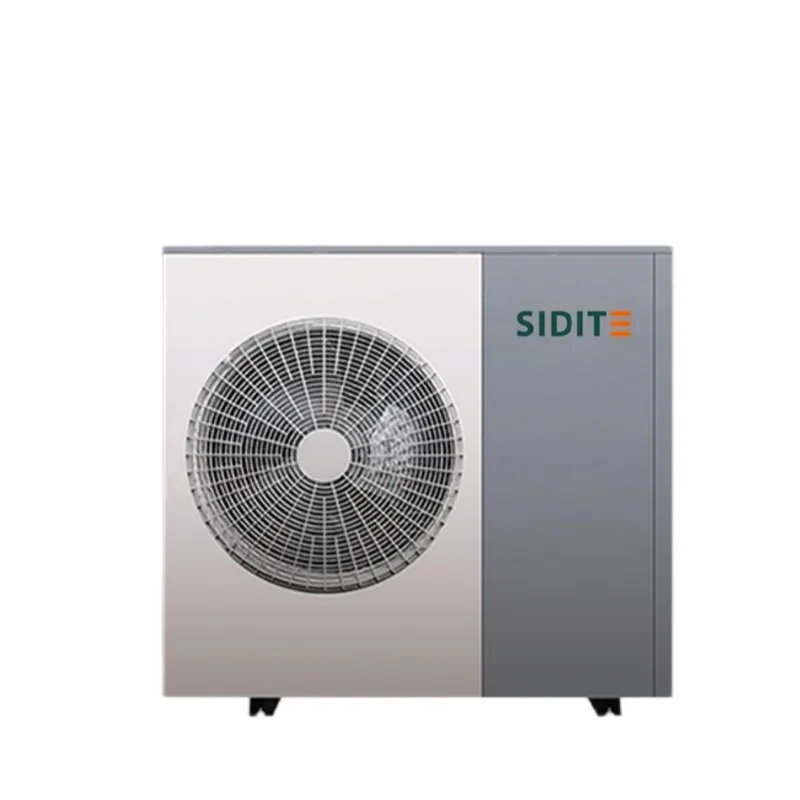
Workers opening the door, fresh-air exchange and changing outdoor conditions all add load to the chamber. The SIDITE full DC inverter unit, model SDTR22DIIBPFC-YL01, is rated for:
· 22 kW heating capacity with 6.28 kW input and a heating COP of 3.5 at the stated test condition
· 19 kW cooling capacity with 6.23 kW input and a cooling COP of 3.05 at the stated test condition
· Operation across an ambient range of -35°C to 45°C
· Chamber temperature control from 0°C to 30°C
These are rated figures, not universal field results. Final capacity should be checked against local design temperatures, chamber insulation, air leakage, crop load and door-opening frequency.
The advantage of full DC inverter control is load matching. Mushroom rooms do not require maximum heating or cooling every minute. The system can adjust output as conditions change rather than relying only on repeated full-output cycling.
Fruiting mushrooms need moisture, but simply making the room wet is not good control. Condensation, stagnant corners and wet surfaces can increase operating problems.
The machine supports a chamber humidity range of 50% to 99% RH and up to 30 kg/h humidification capacity. This capacity helps the room recover when ventilation or door openings remove moisture.
The correct setpoint still depends on mushroom variety, growth stage and surface condition. Sensor placement also matters. A reading taken in direct supply air may not represent the average condition around the racks.
Oyster mushroom form is sensitive to CO2 and air movement. High average airflow does not automatically mean good rack-level distribution.
The system is specified with:
· CO2 control capability from 500 to 10,000 ppm
· 1,500 m3/h fresh-air volume
· 6,000 m3/h circulating-air volume
Fresh air addresses CO2 accumulation. Circulation helps distribute the conditioned air through the chamber. Duct layout, rack spacing and commissioning remain essential. A fan cannot compensate for badly placed supply and return paths.
The machine supports 4G, WiFi and Ethernet communication for remote monitoring and data transfer when connected to the appropriate platform.
This can help a farm identify an open door, abnormal sensor trend or equipment alarm earlier. It can also create a climate record for comparing production cycles.
Remote monitoring does not replace an experienced grower. It gives that person better evidence for making decisions.
This is the section buyers should read before the product brochure.
A heat pump mushroom machine cannot correct:
· Contaminated or poor-quality substrate bags
· An unsuitable strain or substrate formulation
· An unverified crop calendar
· Incorrect climate setpoints
· Poor sanitation and workflow
· Bad rack or duct layout
· Weak local demand or an unrealistic selling price
· Missing labor, packaging and distribution costs in the business plan
It also cannot guarantee identical yield from every production cycle. Mushrooms are biological products. The equipment reduces controllable environmental variation; it does not eliminate biological and commercial risk.
A smart mushroom cultivation chamber deserves closer evaluation when the project has most of the following conditions:
· The farm needs year-round or off-season production.
· Outdoor temperatures regularly move outside the crop's preferred range.
· The planned mushroom has a stable local buyer or contracted sales channel.
· Substrate quality and supply are reasonably consistent.
· The operator can define or obtain a strain-specific cultivation recipe.
· Energy, yield and selling price can be monitored by production cycle.
· Expansion will follow proven demand rather than speculative capacity.
· The model is less convincing when the selling price is unknown, substrate supply is unreliable or the farm has not yet validated basic cultivation skills.
Which mushroom variety will be grown?
1. Will the chamber handle incubation, fruiting or both?
2. What are the site's hottest and coldest design temperatures?
3. How many bags will be loaded, and how are the racks arranged?
4. What temperature, humidity and CO2 recipe will be used at each stage?
5. What power supply and electricity tariff are available?
6. What are the verified local substrate cost, labor cost and selling price?
7. Who will review the crop calendar and commission the airflow?
8. A supplier that receives these answers can prepare a more useful proposal than one quoting from chamber dimensions alone.
No. An air conditioner primarily responds to temperature. A heat pump mushroom machine is designed to coordinate heating, cooling, humidity, fresh air, circulation and CO2 control for a cultivation chamber.
The internal planning worksheet uses 13,500 kWh per year, equivalent to about 37 kWh per calendar day on average. Actual daily use will vary by season, outdoor temperature, setpoints, insulation, door activity and production load.
A 45 kWh/day figure may describe a typical active-production day or a higher-load operating period, while 13,500 kWh is the annual planning figure. These two bases should not be presented as interchangeable. A project proposal should state whether it is quoting an annual average, seasonal average, measured day or modeled peak period.
Using only substrate and climate-control electricity from the base model, the calculated cost is approximately RMB 2.92/kg. This is not the true business break-even price because labor, water, packaging, maintenance, depreciation, losses, tax and sales costs are excluded.
No. The 36,000 kg figure is calculated from stated planning assumptions. Real output depends on crop genetics, bag quality, contamination, climate recipe, crop scheduling and management.
The environmental platform may be configured for selected vegetables, specialty crops, cheese aging, wine storage and other temperature- and humidity-sensitive uses. Each application requires its own internal layout, sanitation standard and control recipe. This article evaluates mushroom production only.
The 3,000-bag model shows why a heat pump mushroom machine can be commercially interesting. It brings several unstable room variables into one coordinated control system and makes energy use easier to estimate.
It also shows why equipment alone is not a business model.
Before investing, replace every planning assumption with local evidence. Confirm the crop calendar. Add all omitted operating costs. Test a downside scenario. Then size the system against local climate and chamber load.
That process may produce a less dramatic headline than a guaranteed payback claim, but it produces a decision a professional farm can defend.

SIDITE Energy provides solar water heaters and heat pump systems for residential and commercial use. Our energy-efficient, low-carbon technologies reduce emissions and save energy. Trusted globally for 19 years. Learn more.
Yuxin Industrial Park, Nanhu Region, Jiaxing, Zhejiang, China
Copyright © 2025 by SIDITE Energy Co., Ltd. Privacy Policy
 EN
EN


 Hot News