A heat pump mushroom machine gives commercial growers a controlled, repeatable production space for mushrooms. It keeps temperature, humidity, CO2, airflow, and fresh air exchange within the target range, even when the outside climate is unstable. For farms, estates, agricultural investors, and mushroom suppliers, the value is simple: fewer climate-related failures, more consistent yields, lower energy waste, and a clearer return on investment.
Mushroom farming looks simple from the outside. Put substrate in a room, keep it humid, wait for fruiting, harvest. Anyone who has managed a real grow room knows it is not that forgiving.
A small temperature drift can delay pinning. Too much CO2 can stretch stems and reduce cap quality. Poor air circulation creates wet corners, dry shelves, and uneven harvests. If humidity swings too hard, mushrooms lose weight and appearance before they even leave the chamber.
That is why more commercial growers are moving from traditional greenhouses and improvised grow rooms to purpose-built heat pump mushroom machines. The machine is not only a cooling and heating device. It is the environmental core of a smart mushroom cultivation chamber.
This article uses mushroom production as the main example because mushrooms are highly sensitive to microclimate. The same controlled chamber logic can also serve other temperature- and humidity-sensitive uses, including leafy vegetables, specialty crops, cheese aging, wine storage, and other products that need stable environmental conditions.
The commercial reason is clear. Demand for mushrooms continues to grow, but stable production is harder to achieve with basic facilities.
Grand View Research estimates the global mushroom market at USD 65.6 billion in 2024, with projected growth to USD 156.3 billion by 2033 at a 10.2% CAGR. At the same time, weather risk is becoming harder for farms to ignore. The American Farm Bureau reported that major 2024 weather and fire events caused more than USD 20.3 billion in crop and rangeland losses in the United States.
For a mushroom grower, those numbers point to one practical question:
How do we produce reliably when the market wants more product, but the climate is less predictable?
A heat pump mushroom machine answers that question by moving production into a controlled environment.
A heat pump mushroom machine is an integrated environmental control system designed for mushroom cultivation rooms, container farms, or modular growing pods. It manages the key variables that determine mushroom quality:
In the SIDITE system, the heat pump unit works with sensors, IoT control, airflow design, and chamber insulation to maintain a stable growing environment. The goal is not just to make the room cold or warm. The goal is to keep the mushroom crop inside a narrow biological comfort zone.
For commercial buyers, that difference matters.
A standard air conditioner reacts to temperature. A mushroom climate control system manages the full growing environment.
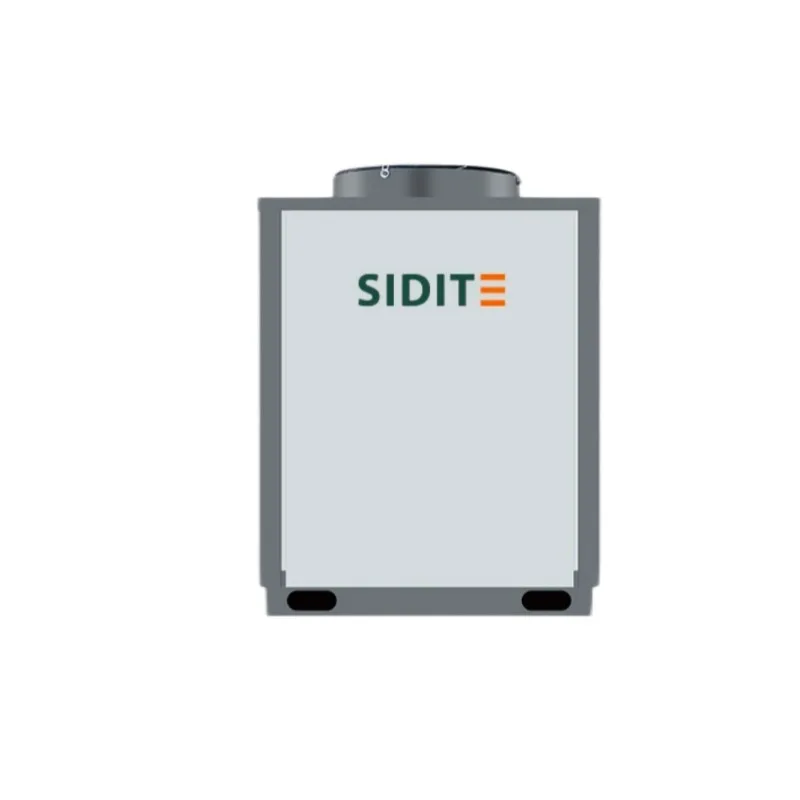
The following specifications are based on the SIDITE full DC inverter smart cabin heat pump unit.
|
Item |
Specification |
|
Product Name |
Full DC Inverter Smart Cabin Heat Pump Unit |
|
Model |
SDTR22DIIBPFC-YL01 |
|
Power Supply |
380V 3N~ 50Hz; optional 220V |
|
Protection / Waterproof Rating |
Class I / IPX4 |
|
Heating Capacity |
22 kW |
|
Heating Input Power |
6.28 kW |
|
Heating COP |
3.5 |
|
Cooling Capacity |
19 kW |
|
Cooling Input Power |
6.23 kW |
|
Cooling COP |
3.05 |
|
Maximum Humidification |
30 kg/h |
|
Fresh Air Volume |
1,500 m3/h |
|
Circulating Air Volume |
6,000 m3/h |
|
Ambient Operating Range |
-35°C to 45°C |
|
Cabin Temperature Range |
0°C to 30°C |
|
Cabin Humidity Range |
50% to 99% RH |
|
CO2 Concentration Range |
500 to 10,000 ppm |
|
Communication |
4G / WiFi / Ethernet |
|
Refrigerant / Charge |
R32 / 3.8 kg |
|
Unit Type |
Integrated unit |
|
Outdoor Unit Size, Excluding Air Outlet |
1700 x 630 x 2800 mm |
|
Outdoor Unit Size, Including Air Outlet |
1700 x 1100 x 2800 mm |
These parameters are important because mushroom rooms need both capacity and accuracy. A weak system may work in mild weather but fail during hot afternoons, cold nights, or high-density fruiting periods when CO2 and humidity loads rise quickly.
Mushrooms do not need one fixed temperature throughout the entire cycle. Incubation, pinning, fruiting, and post-harvest holding often require different setpoints.
The SIDITE unit supports a cabin temperature range of 0°C to 30°C and can operate outdoors from -35°C to 45°C. That gives growers a wider operating window in regions with hot summers, cold winters, or large day-night temperature swings.
From an engineering point of view, this is where the heat pump makes sense. Instead of using high-resistance heating or separate cooling systems, the full DC inverter heat pump adjusts output according to load. That helps reduce energy waste during partial-load operation, which is common in real farms.
Mushrooms have high water content and respond quickly to dry air. Low humidity can reduce weight, crack caps, and affect appearance. Excess moisture can encourage disease and uneven growth.
The machine supports 50% to 99% relative humidity with up to 30 kg/h humidification capacity. For commercial mushroom rooms, this matters during fruiting, when both humidity demand and air exchange demand increase at the same time.
A grower can increase fresh air without losing control of the room. That is the difference between a stable chamber and a room that needs constant manual correction.
CO2 is one of the most common causes of poor mushroom form. When CO2 stays too high, many mushroom varieties develop long stems, smaller caps, and inconsistent shape.
The SIDITE system supports CO2 control from 500 to 10,000 ppm, with 1,500 m3/h fresh air volume and 6,000 m3/h circulating air volume. This combination helps remove excess CO2 while keeping the internal air mixed.
Good airflow is not only about ventilation. It is about uniformity. In a poorly designed room, mushrooms near the air outlet grow differently from mushrooms in corners or upper shelves. That variation becomes visible during harvest and sorting.
Commercial farms rarely operate just one room forever. Once the model works, operators add more chambers.
The system supports 4G, WiFi, and Ethernet communication, allowing remote monitoring, data records, and control-center management. For owners, this helps reduce reliance on one experienced technician walking from room to room with a thermometer.
The farm team can track temperature, humidity, CO2, operating status, and alarm records. If an issue appears, the operator sees it earlier and acts faster.
|
Factor |
Traditional Grow Room |
Heat Pump Mushroom Machine Chamber |
|
Temperature Stability |
Often affected by outside climate and manual control |
Controlled by inverter heat pump and sensors |
|
Humidity Control |
Manual misting or simple humidifier |
50% to 99% RH, up to 30 kg/h humidification |
|
CO2 Control |
Basic exhaust, often unstable |
500 to 10,000 ppm range with fresh air and circulation |
|
Energy Use |
Separate heating, cooling, and ventilation can waste energy |
Integrated heat pump with COP 3.5 heating and COP 3.05 cooling |
|
Labor Requirement |
Frequent manual checks |
Remote monitoring through 4G/WiFi/Ethernet |
|
Scalability |
Hard to copy exactly room by room |
Modular chamber model, easier to repeat |
|
Crop Uniformity |
Depends heavily on operator experience |
More consistent microclimate across batches |
The main advantage is not one single feature. It is the way the system connects the whole environment. Mushrooms care about the combined effect of temperature, moisture, CO2, airflow, and timing. A good chamber manages these variables together.
A heat pump mushroom machine is a capital investment. Buyers usually care about four numbers before they move forward:
1.How much can one chamber produce?
2. How much electricity will it use?
3. How many workers are needed?
4. How long before the equipment pays back?
Based on SIDITE project data for a 12m x 3m x 2.8m smart mushroom chamber, annual electricity consumption is about 13,500 kWh in a typical calculation model, or roughly 45 kWh per day. Actual consumption varies by climate, setpoint, crop stage, insulation, loading density, and operating method.
In internal return models, common mushroom varieties such as oyster mushroom, shiitake, white beech mushroom, snow lotus mushroom, tremella, lion's mane, and king oyster mushroom can generate attractive yearly returns when local selling prices and substrate costs are favorable.
A separate Sri Lanka project model using three standardized chambers estimated:
Monthly output:
Total project investment:
Estimated monthly net profit:
Estimated payback period:
These figures should not be treated as a universal guarantee. They depend on local mushroom prices, electricity cost, substrate cost, labor cost, sales channel, and management level. Still, they show why growers are paying attention to controlled mushroom production: the model is easier to calculate than weather-dependent farming.
This equipment is best suited for buyers who need stable output and repeatable management.
For existing farms, the machine can support year-round production, trial new varieties, and reduce seasonal fluctuations.
For investors entering mushroom production, the chamber provides a more standardized starting point than building a custom greenhouse from scratch.
For estates, farms, restaurants, and B2B fresh produce suppliers, the system can support premium mushroom production close to the point of sale.
Although this article uses mushrooms as the core case, the same climate chamber can also be configured for leafy vegetables, specialty crops, cheese aging, wine storage, and other products that require controlled temperature and humidity.
Before purchasing a heat pump mushroom machine, confirm these points with the supplier:
A serious supplier should not only quote the machine. They should help calculate the production model.
The cabin temperature can be controlled from 0°C to 30°C, while the unit can operate in ambient temperatures from -35°C to 45°C.
Yes. The system supports 50% to 99% RH and provides up to 30 kg/h humidification capacity, which is suitable for high-humidity mushroom production environments.
Yes. The system supports CO2 concentration control from 500 to 10,000 ppm, with 1,500 m3/h fresh air volume and 6,000 m3/h circulating air volume.
No. Mushrooms are the main example in this article because they require strict environmental control. The same controlled chamber concept can also support leafy vegetables, specialty crops, cheese aging, wine storage, and other products that need stable temperature and humidity.
Project models vary. In a three-chamber commercial mushroom project model, estimated payback can be 8 to 12 months under favorable market and operating conditions. A custom ROI calculation is recommended for each region.
A heat pump mushroom machine is not just a piece of HVAC equipment. It is a production control system for commercial mushroom farming.
For growers who want to reduce climate risk, improve batch consistency, and scale production with clearer operating data, a smart mushroom cultivation chamber offers a practical path forward. The best results come when the equipment, crop plan, and sales model are designed together.
If you are planning a mushroom farm, expanding an existing facility, or comparing greenhouse and container-based production, send us your target variety, local climate, electricity rate, and expected output. SIDITE can prepare a technical configuration and ROI estimate for your project.

SIDITE Energy provides solar water heaters and heat pump systems for residential and commercial use. Our energy-efficient, low-carbon technologies reduce emissions and save energy. Trusted globally for 19 years. Learn more.
Yuxin Industrial Park, Nanhu Region, Jiaxing, Zhejiang, China
Copyright © 2025 by SIDITE Energy Co., Ltd. Privacy Policy
 EN
EN


 Hot News